This site is dedicated to everyone keen to learn about the upcoming snap state (DUN) elections in Johor (2026).
Johor has 56 DUN constituencies and 26 Parliamentary constituencies.
For more information, contact us via danesh@tindakmalaysia.com
Sections of this website:
Below is the map of Malaysia showing electoral and administrative boundaries. For the purpose of the website, we encourage that you zoom in to Johor. Please explore the tools found in the bottom of the map application.
We recommend that you verify your voting status with SPR website.
Do you want to get involved in the election process? With the announcement of candidates on 27th June 2026, several political parties are recruiting Polling Agents, Counting Agents, and Barung Agents (PACABA) – the eyes and ears of the candidate in the saluran. We have developed a simple Johor 2026 PACABA map so you know where and whom to serve.
Access our credible research on election results and demographics of all 56 Johor DUNs from a single Google Sheet. Contents are dynamically updated from time to time (last revised on 12/7/2026). Please do read our metadata before using the dataset. The minimum citation must be given:
JOHOR ELECTION SITE – Tindak Malaysia. (2026, June 25). Tindak Malaysia. https://www.tindakmalaysia.org/home/johor-election-site
For past and including 2026 election data, please visit our Tindak Malaysia GitHub (Historical Election Results)
For any errors, please communicate to danesh@tindakmalaysia.com backed with credible evidence.
The Google Sheet will remain until election day and a few days thereafter. Subsequently, it will be removed, as future references shall be directed to our GitHub.
Source: Tindak Malaysia’s GitHub
For DUN specific Turnout of Johor, visit here
For Early Vote Turnout of Johor, visit here
| Time | SABAH (2020) | MELAKA (2021) | SARAWAK (2021) | JOHOR (2022) | GE15 (2022) | SIX STATE ELECTIONS (2023) | SABAH (2025) | JOHOR (2026) |
|---|---|---|---|---|---|---|---|---|
| 9:00 AM | 11 | 7 | 11 | 6.35 | 9 | 10 | 10.14 | 7.97 |
| 10:00 AM | 22 | 17 | 22 | 13.56 | 20 | 20 | 21.05 | |
| 11:00 AM | 32 | 27 | 32 | 21.33 | 31 | 29 | 31.29 | 26.43 |
| 12:00 PM | 41 | 36 | 39 | 28.41 | 42 | 38 | 39.37 | 34.78 |
| 1:00 PM | 48 | 43 | 44 | 34.51 | 50 | 45 | 45.5 | 42.16 |
| 2:00 PM | 54 | 50 | 48 | 39.71 | 58 | 51 | 51.19 | 48.91 |
| 3:00 PM | 59.09 | 57 | 52 | 45.39 | 68 | 58.7 | 56.78 | 56.77 |
| 4:00 PM | 62.09 | 61 | 55 | 49.63 | 70 | 64.7 | 60.94 | 63.13 |
| 5:00 PM | 53.13 | 67.44 | ||||||
| 6:00 PM | ||||||||
| Final Turnout | 66.61 | 65.85 | 60.67 | 54.92 | 73.89 | 70.73 | 64.35 | 68.73 |
With every seat up for grabs in the 2026 elections, now is the time to uncover the stories behind the numbers. Powered by our election datasets, this dashboard (best viewed on desktop) lets you explore the dynamics of parties, coalitions, and constituencies like never before.
Compare candidate demographics with the communities they seek to represent, examine party and coalition voter bases, and discover insights that go beyond headline figures. Unlike other election dashboards, ours helps you understand what the numbers reveal about representation, electoral strategies, and political trends.
Want to test your own election scenarios? Our updated election simulator lets you translate the latest political developments into custom seat projections, giving you the flexibility to explore how different outcomes could reshape the electoral landscape.
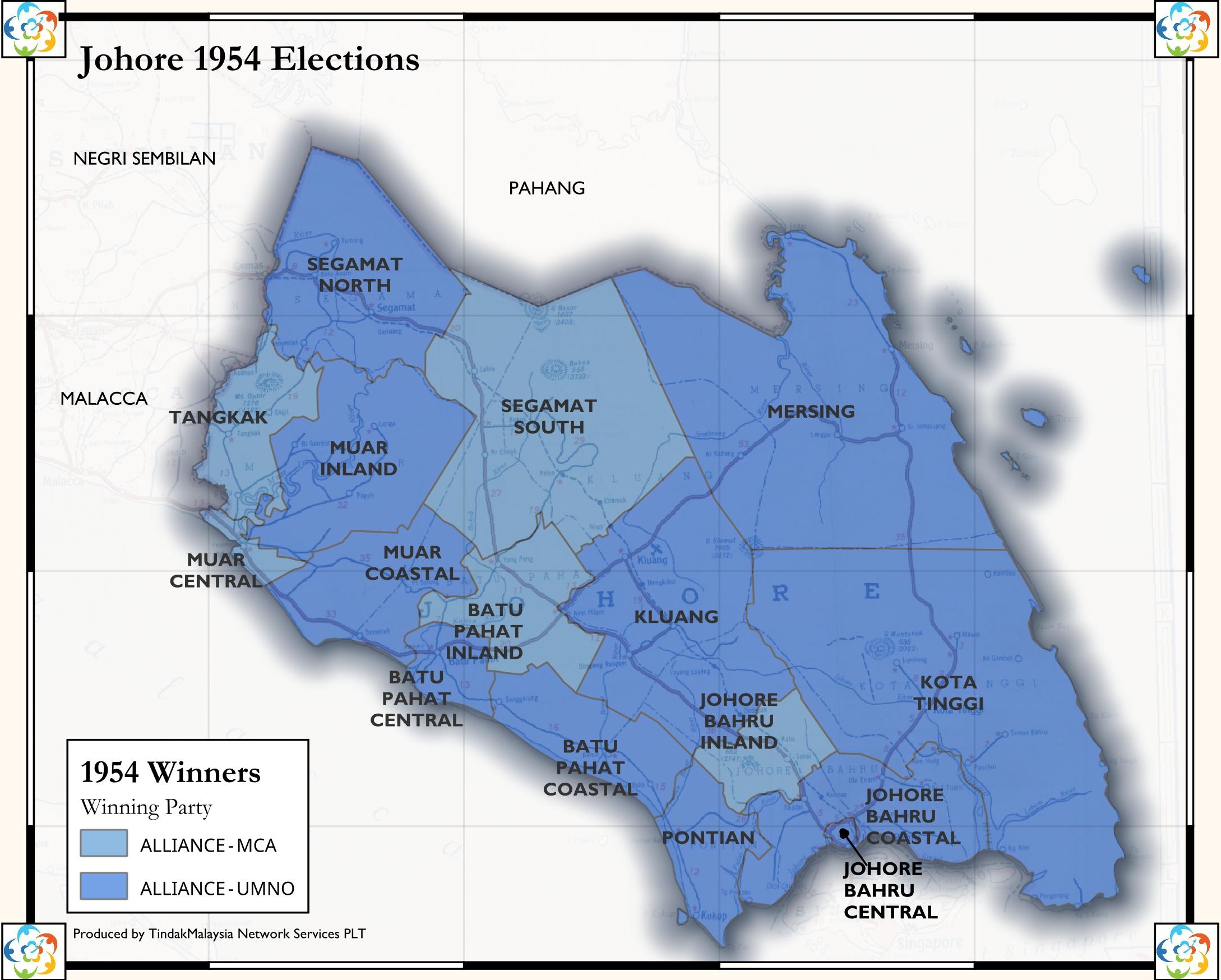
Did you know Johor (then Johore) was the first state to start state level elections? According to Tindak Malaysia’s research, Johore also happens to be first state where the formation of geographical constituencies (for DUN/ Parliament) occurred. Here are key dates leading up to state elections:
June 1950 – Select Committee of the Council on State, Johore on the Question of Election of Members of Council convenes their first meeting (Source; The Straits Times, 23 June 1950, Page 5)
October 1950 – Johore becomes the first Malay state to produce a report recommending elections to the State Legislature. The Committee recommended that one elected member shall represent 50 000 people of the state (not necessarily just voters). Hence, 16 elected members were proposed for Council of State
June 1953 – Appointment of officers (5) to manage 16 new constituencies with intention of dividing up the new polling areas (with voter cap of 1000 electors per polling area) (Source: The Straits Times, 15 June 1953, Page 7)
June 1954 – Registers of voters for State Elections were completed and open for inspection (Source: The Straits Times, 28 June 1954, Page 4)
September 1954 – Nomination Day. Alliance (UMNO-MCA) won five seats uncontested (Kota Tinggi, Batu Pahat Coastal, Pontian, Kluang and Mersing) (Source: Singapore Standard, 2 September 1954, Page 2)
October 1954 – Polling Day (10/10/1954). Alliance swept through all seats.
Election Results and Metadata for 1954 Johore Elections can be accessed here: https://github.com/TindakMalaysia/HISTORICAL-ELECTION-RESULTS/tree/main/1955-ELECTION-RESULTS
Map Source/ Report Details: “Policy. Elections,” 1950, CO 717/186/11, MS Records of the British Colonial Office, The National Archives, State Papers Online Colonial (Gale)
Following sections were developed in 2022 for then Johor State Elections. The contents are now archived as below.
Below here is the Tableau visualization of Electorate (for optimal viewing, please click this link) Growth of every DUN with key attributes (urban-rural classification, party and coalition groups) from 2016 to 2019. The implementation of Undi 18 resulted in addition of 700 000 new voters into the electoral roll of Johor
Play around various filters to understand how different DUNs have grown or growth patterns by party and urban-rural classification
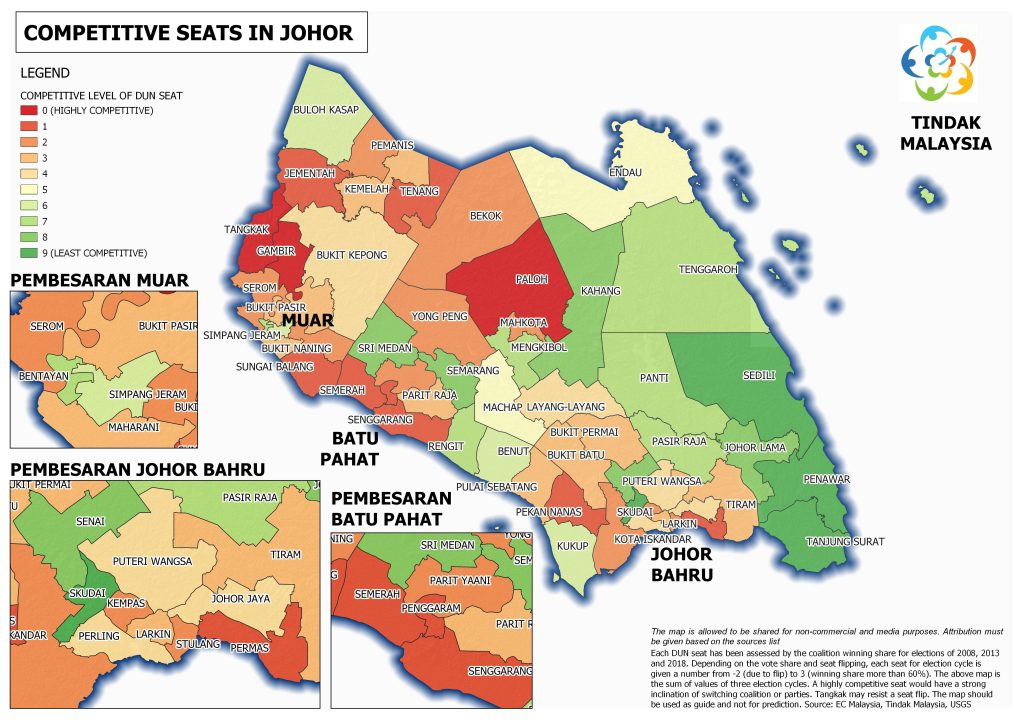
Below is the map showing how competitive each DUN seat for Johor may be for the coming 2021 elections. Suitable for Pemerhati (Election Observation) and general planning for elections
Not to be used for predictions
Each seat was examined of their winning vote share of 2008, 2013 and 2018 General elections with the track record of flipping seats. For various vote shares and events of seat flipping during an election, each seat is numbered (ranked) from -2 (for a seat that switched coalitions during an election) to 3 (winning vote share of incumbent coalition with more than 60%). The map below shows the sum of these numbers for past three election cycles
Below here is the Tableau Visualization of demographic breakdown by DUN with filters for contesting parties. Play around with the filters (for the DUN Name, Urban-Rural Classification, and Contesting Coalition) to study the type of demographics at the aggerate or at the DUN level.
Terms of usage as per the Tableau Visualization description (For all non-commercial and media purposes
For optimum usage, head here
*Null represents no participation by the party or Coalition for the given DUN
For access to Johor Elections Results and Composition of 2022, please refer to our GitHub link
Compulsory Attribution: As per the metadata files
The contents of the GitHub shall be updated from time to time
Below here is the Tableau visualization to allow you to discern any form of relationship between urbanization, key economic indicators and malapportionment. Play around the filters from Parliament Seat Name to seats that are above or below State Poverty Incidence of 2019
Terms of usage as per the Tableau Visualization description (For all non-commercial and media purposes
For optimum usage, please head here
Compulsory Attribution: SPR Malaysia (or Election Commission of Malaysia), Department of Statistics, Malaysia, Tindak Malaysia (2022),data.gov.my